
Planetary Health Check 2026: Seven out of nine planetary boundaries have already been significantly exceeded

Planetary boundaries describe nine key processes of the Earth system. If their safe operating spaces are exceeded, the risk increases that our planet’s vital systems will undergo permanent changes.

The 2026 Planetary Health Check reveals a clear trend: Seven of the nine planetary boundaries are now outside the safe operating space. Most recently, in 2025, the boundary for ocean acidification was also exceeded.

This affects climate change, the integrity of the biosphere, changes in land use, changes in the freshwater cycle, biogeochemical cycles, the introduction of anthropogenic substances, and ocean acidification.

The situation has improved over the past decade only with regard to the ozone layer and global aerosol pollution in the atmosphere. Regarding aerosols, however, the report points out that global trends may mask regional pollution levels.


A Year of Extreme Events Highlights Growing Risks

The report examines the evolution of planetary boundaries in relation to numerous extreme events on land and in the oceans. The severity of their consequences depends not only on the climate, but also on the state of ecosystems, water availability, land use, and people’s ability to adapt to change.

In 2025, more than 6.9 million people in Pakistan were affected by monsoon floods. At the same time, the heat content of the oceans reached a new record high.

The impact is particularly evident in the oceans: From January 2023 to September 2025, approximately 84.4 percent of the world’s coral reef area was exposed to heat stress, which can trigger coral bleaching. According to the report, this was the largest event of its kind ever observed worldwide.

Europe was also affected by extreme weather conditions. In 2026, Western Europe experienced its hottest June and July on record. At the same time, severe droughts struck France, Spain, Germany, and the United Kingdom. Severe wildfires broke out in Europe and Canada. Japan, South Korea, and parts of the Middle East also recorded record-breaking temperatures.

The report’s key message: These developments should not be viewed as separate crises. Climate, water, ecosystems, land, and oceans all influence one another.


Natural Carbon Sinks Under Pressure

Natural carbon sinks play a special role. Vegetation and soils absorb a significant portion of human-caused CO₂ emissions.

However, recurring heat waves, droughts, wildfires, and damaged ecosystems can reduce this absorption. As a result, ecosystems in some regions may transform from CO₂ sinks into CO₂ sources.

The Planetary Health Check therefore also examines whether models of terrestrial carbon sequestration may be overestimating their resilience. This is relevant because the path to net-zero emissions also depends on natural carbon sinks continuing to function.


Why the planetary boundaries are interconnected

The seven boundaries that have been crossed show that environmental changes cannot be viewed in isolation from one another. For example, deforestation affects the climate and the water cycle. Rising temperatures, in turn, impact ecosystems and the oceans.

At the same time, trends in the ozone layer show that improvement is possible. International measures have helped reduce the pressure on this Earth system.

The challenge, therefore, is not merely to prevent further overshoots. In the long term, the goal is to bring the planetary boundaries that have already been exceeded back toward a safe range.


Learn More

Planetary Health Check 2026
https://www.planetaryhealthcheck.org/

Original publication: Planetary Boundaries Science (PBScience), 2026: Planetary Health Check 2026. Potsdam Institute for Climate Impact Research, Potsdam, Germany.


How much electricity and water do Europe's data centers use?

Artificial intelligence seems to operate almost effortlessly on our smartphones and computers. Behind the scenes, however, lies a massive physical infrastructure: data centers with thousands of servers, high-capacity power connections, and sophisticated cooling systems.

With the boom in artificial intelligence, this infrastructure is currently growing at a particularly rapid pace. This is also driving up the demand for electricity, water, and suitable locations.

The European Union therefore wants to gain a more accurate understanding of how efficiently Europe’s data centers actually operate. Operators of large facilities are expected to make their energy and water efficiency more transparent. There are also plans to establish a European rating system for the sustainability of data centers.


2.5 percent of Europe's electricity consumption

Data centers already account for about 2.5 percent of the European Union’s total electricity consumption. And demand is expected to continue to rise significantly.

According to current forecasts, the installed capacity of European data centers could more than double, from about 12 gigawatts in 2025 to about 28 gigawatts in 2030.

Artificial intelligence is a key driver. Not only does training large AI models require enormous computing power, but their day-to-day use also runs on high-performance servers that must be operated and cooled.


Water is also becoming an issue

Water consumption is less obvious. Servers generate large amounts of heat. As a result, many data centers use cooling systems in which water plays an important role.

The actual amount of water required depends heavily on the location, the technology used, and the cooling system. This is particularly relevant in regions where water is already in short supply.

This also gives new significance to the choice of location. In addition to fast data connectivity and sufficient electricity, the local availability of energy and water, as well as climatic conditions, are becoming increasingly important.


Waste Heat Is Converted into Energy

At the same time, data centers offer the possibility of reusing a portion of the energy they consume.

Servers continuously generate heat. This waste heat can, for example, be fed into district heating networks and used to heat homes, offices, or public buildings.

Such concepts are already being implemented in several European cities. This can turn a byproduct of digitalization—which has often gone unused until now—into a local heat source.


Efficiency Is Becoming a Competitive Advantage

The key question is not whether Europe will need data centers in the future. Digitalization, cloud services, and artificial intelligence will continue to drive up the demand for computing power.

The key factor is how this infrastructure is built and operated.

Renewable electricity, more efficient chips and servers, smart cooling systems, the use of waste heat, and suitable locations can all influence resource consumption.

The issue is also gaining importance from an economic perspective. When it comes to operating large data centers, energy is not just an environmental issue, but a significant cost factor.

The digital future is by no means intangible. Behind every AI application are real buildings, servers, and resources. The more artificial intelligence is used, the more important the efficiency of the underlying infrastructure becomes.

As the night grows quieter: One in nine moths in Europe is endangered

They usually fly unnoticed through the darkness and receive far less attention than bees or butterflies. Yet moths play important roles in Europe’s ecosystems.
A new comprehensive survey shows just how much pressure this group of animals is under: Nearly 11 percent of the European moth species studied are considered threatened with extinction. Within the European Union, the figure is as high as nearly 12 percent.
This means that roughly one in nine species is endangered.

More than 3,000 species studied
A total of 3,082 moth species were assessed for the new European Red List. Among them are 704 species found exclusively in Europe.
The study is the first comprehensive assessment of the extinction risk for European moths based on the criteria of the IUCN Red List.
At the same time, there are significant gaps in our knowledge. For about one in four of the species studied, the available data are insufficient to reliably determine their conservation status. Among species found exclusively in Europe, this figure rises to about 35 percent.

Why Moths Are Important
Moths are often underestimated. Many species contribute to plant pollination. At the same time, they serve as an important food source for numerous other animals, including birds and bats.
They also play a role in the nutrient cycle and are closely linked to specific plants and habitats. Some species are highly specialized and depend on single host plants or specific climatic conditions.
If moths disappear, this can therefore have an impact on entire food webs and ecosystems.
Habitats are disappearing—and the nights are getting brighter
Among the most significant threats are the alteration and degradation of natural habitats, as well as climate change. Added to this are intensive agriculture, pesticides, environmental pollution, habitat fragmentation, and artificial

Light in the Night.
Light pollution, in particular, poses a significant problem for nocturnal insects. Streetlights, illuminated buildings, and other artificial light sources alter the natural darkness and can interfere with orientation, foraging, and reproduction.
This makes the way cities and towns are lit at night a matter of species conservation.
Not every night has to be bright
Some of this impact can be reduced relatively easily. Light can be used more selectively, directed downward, and reduced during the night hours when it is least needed.
At the same time, moths need sufficient near-natural and interconnected habitats. The protection and restoration of such areas are therefore just as important as reducing environmental pollution and unnecessary artificial light.
The fact that moths go largely unnoticed does not make their decline any less significant. For the first time on this scale, the new Red List reveals the state of this largely invisible aspect of European biodiversity.
Species conservation therefore does not take place only in large protected areas. It also begins in meadows and fields, in gardens and parks—and sometimes with a very simple measure: restoring more darkness at night.

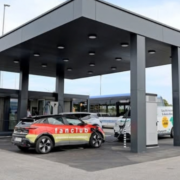
First Energy Station Instead of a Gas Station

The mobility transition requires more than just electric cars—it requires an infrastructure that is reliable, fast, and sustainable. With the opening of the first central energy station for electric vehicles in Mattersburg, Burgenland is now breaking new ground: Instead of traditional charging stations, a facility is being created that combines energy supply, service, and regional electricity production.

More Than Just a Charging Station
The new facility was designed to mirror the familiar processes of a traditional gas station. In addition to fast-charging stations for cars and buses, it also features a café, a shop, and restrooms.
The key difference, however, lies in the energy concept: The station has its own photovoltaic system and a battery storage unit. This allows part of the electricity needed to be generated and temporarily stored directly on-site. The supply is supplemented by wind and solar power from Burgenland.
This combination reduces grid peaks, increases the reliability of supply, and boosts regional economic value creation.

A Network for All of Burgenland
The energy station in Mattersburg is not intended to remain a standalone project. The plan is to build a similar facility in every Burgenland district in the future.
The goal is a comprehensive network of high-performance charging centers that will facilitate the transition to electric mobility even outside metropolitan areas.
With this approach, the charging infrastructure is evolving from individual charging stations to self-sufficient energy hubs that can generate, store, and supply electricity as needed.

Why Battery Storage Is So Important
Fast-charging stations, in particular, experience very high power demands over short periods of time. Battery storage systems can cushion these peak loads by providing previously stored energy within a matter of seconds.
This reduces the strain on the power grid while enabling high charging power—even when multiple vehicles are charging at the same time.
In combination with solar power, a larger share of locally generated renewable energy can also be used directly on-site.

Why Rain Alone Won't Solve Europe's Water Problem

Many regions in Europe have been struggling for years with drought, falling groundwater levels, and parched soil. When it finally rains heavily again, it’s easy to get the impression that the problem has been solved.
But that is often not the case.
A single heavy rain event can fill rivers and moisten the topsoil. However, a sustainable recovery of water reserves requires much more than that.

Why Rain Doesn’t Automatically Seep into the Soil
It’s not just how much rain falls that matters, but also how quickly it falls and what kind of soil it falls on.
After long dry spells, many soils are severely parched and initially have a harder time absorbing water. Especially during heavy rainfall, a large portion runs off the surface before reaching deeper soil layers or the groundwater.
This can even lead to a paradoxical effect: Flooding occurs while groundwater levels remain low at the same time.

Heavy rain is no substitute for steady rain
Steady, prolonged rainfall is particularly valuable for water reserves.
It can slowly seep into the ground and supply plants, forests, and groundwater reservoirs.
Heavy rain, on the other hand, falls in large quantities over a short period of time. Sewer systems, soil, and rivers are often unable to absorb these volumes of water.
A significant portion is therefore quickly carried away again.

Groundwater Reacts Slowly
Groundwater levels change much more slowly than those of rivers or lakes.
It can take weeks or even months for rainwater to seep deep enough into the ground to actually reach groundwater reserves.
In some regions, a few months of heavy rainfall are therefore not enough to make up for deficits accumulated over several dry years.

Timing also plays a role
Rain in winter often has a greater effect on groundwater than precipitation in summer.
In summer, a significant portion of the water evaporates or is absorbed directly by plants.
In winter, evaporation is lower, allowing more water to seep into deeper soil layers.
That is why winters with heavy precipitation are particularly important for long-term water supply.

Sealed surfaces exacerbate the problem
In cities and densely built-up areas, rainwater often cannot seep into the ground.
Roads, parking lots, and buildings channel the water directly into sewer systems and rivers.
As a result, valuable water is lost that could otherwise contribute to groundwater recharge.
Unsealing surfaces, green spaces, stormwater retention basins, and so-called “sponge city” concepts can help keep water in the landscape longer.